Design Equity Assesment

Assessment boosts design equity understanding and client acquistion
My Role
Product Design
Intern
Skills
Visual Design
Design Systems
Equity-Centered Design
Duration
June - Aug 2022
(3 months)
Collaboration
UX Research Intern
Tools Used
Figma
Dovetail
Miro

Overview

The Problem

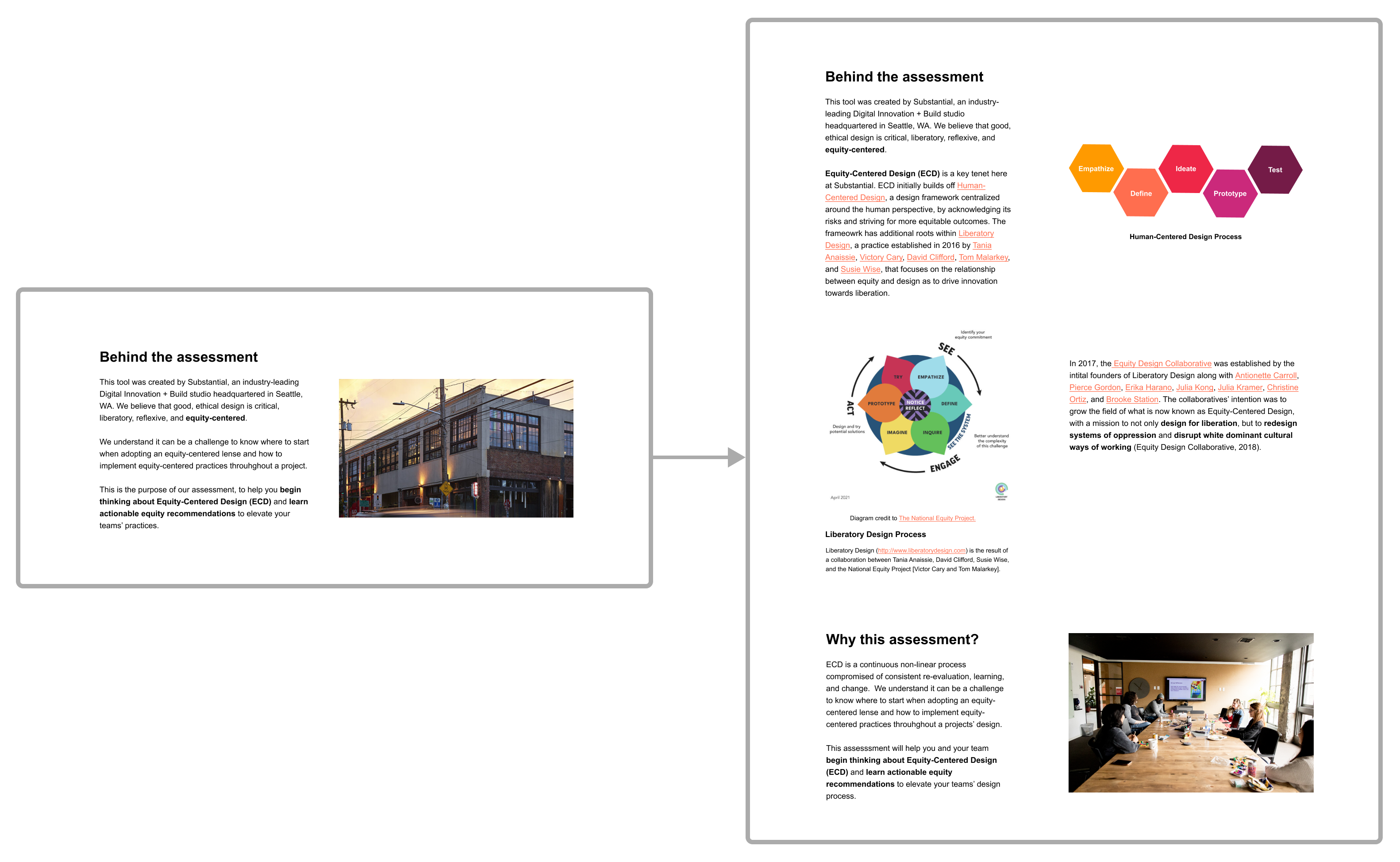
During my internship at Substantial, my co-intern and I developed an Equity-Centered Design (ECD) assessment and client acquisition tool, drawing from the organization’s early-stage internal projects. ECD is a core principle at Substantial, building on Human-Centered Design by centering the voices and needs of historically underserved communities. It focuses on building relational trust, recognizing oppression, and transforming power dynamics.

As a newer framework, ECD can be challenging to fully understand and implement, and without careful application, products may unintentionally perpetuate inequities and non-inclusive practices.

Impact

100%
LEADERSHIP APPROVAL
$XXX
FUNDING SECURED
2
ENGINEERS SCOPED

The Solution

I designed a web app that provides a palatable introduction to ECD, with a multi-step assessment for team's to identify design process equity maturity, gain actionable recommendations, and connect with Substantial experts to further expand assessment insights. This tool not only acts as a customer-acquisition funnel, but establishes a strong foundation to build more equitable products.
I showcased the project with my co-intern during company-wide and leadership presentations. Our solution received wide-spread approval, impressing leadership and gaining funding for additional UX and engineering support.
OverviewHighlightResearchDesignFinal DesignReflection

Research

Research Methods Used

Expert Interviews
Secondary
Secondary
Competitive Analysis
Primary

Competitive Analysis

I examined equity-centered design educational and supportive solutions that currently exist on the market. Limitations with these current platforms included generalized recommendations, difficulty gauging support areas, absence of comprehensive guidance, and lack of interactivity.

Outcome: I concluded that there was not an ECD resource that necessarily provides an informative, supportive, and engaging experience for teams to elevate their design practices to a more equitable level.
Equity-Centered Design Tools

01 - Spectrum

  • "ECD is not static, it involves continuous learning, understanding, and growth...it can be self-assessed or via a third party, but together works best."

02 - Complexity

  • "The complexity of ECD makes it less palatable for those unfamiliar with the framework...for instance terminology is very inconsistent and there are many equity subtracts."

03 - Lack of foundation

  • "Clients are often not sure how to become equity-minded...they are not always well-versed in design or ECD terms, concepts, and tools."

04 - Practices

  • "...build capacity to understand the value of ECD and using an ECD lens."

05 - Assessment

  • "Lot's of judgement based assessment to see where client need equity work."

Generated Themes

Expert Interview
Thematic Analysis


Goal: We conducted several semi-structured interviews with Substantial ECD practitioners as to gain a deeper understanding of the the equity design space, including its tenets, implementations, and challenges within an industry setting.

Data coding + Theme Generation: Using Dovetail, we coded our interview transcripts as to get an overview of the shared meanings our our interviews. 

I then inductively consolidated coded data into several themes for a more comprehensive overview. Example themes are included below.

The Bottom Line


ECD is a progressive process that is difficult to understand, implement, and assess due to the complexity of the framework and embedded industry practices, but it is necessary to build that capacity as to develop empowering, equitable products.

Design

Solution Framing

Simple + Palatable
solution should avoid overcomplexities as to encourage stakeholders to engage with ECD practices and thinking
Informative + Structured
platform must offer a structured, informative experience in order to boost user understanding and solution utility
Engaging + Interactive
platform must be engaging and interactive to improve information and user retention
Design Challenge
How might we create a tool to assist project teams in effectively identifying and improving their design process equity maturity?

Ideation

Primary Features
Terminology Guide
Consolidated guide with ECD key terms and definitions to prompt initial equity thinking and improve user understanding of the framework and platform copy.
Design Process Assessment
Users will answer a brief yet provoking series of design process equity questions through an interactive assessment, encouraging equity-based reflection within an non-intensive, introductory environment.
Assessment Results
Users are presented with a design process equity maturity level accompanied with actionable recommendations to elevate their process equity and a prompt to connect with Substantial experts for further guidance.
Secondary Features
Community Representation
Include visual elements from historically and systemically marginalized communities to provide visibility, representation, and empowerment, all key tenets of ECD and Substantial.
Platform Navigation
Each page will have tailored components that allow for page traversal when appropriate, improving platform usability and flexibility.
Source Acknowledgement
All elements from external sources will have clickable acknowledgements to credit the creators and prompt users to further explore the ECD space, improving platform utility and equity.

Iteration

Initial Wireframes (Low-Fidelity)

I jumped into Figma to build out low-fidelity mockups, which allowed us to investigate initial product copy, information hierarchy, and interaction flows.

Visual Language Decisions

Visual Language

Project Scoping

Target User
Our research indicated ECD can guide an individual, project team, or organization, but practices differ in complexity and implementation.

This platform is designed for project teams  due to the scope of Substantial's clientele and internship feasibility.
The typefaces and colors utilized in my high fidelity wireframes reflect those outlined in Substantial's brand guidelines. I created the design guide below for reference to ensure my work remained consistent with the set visual language parameters moving forwards.

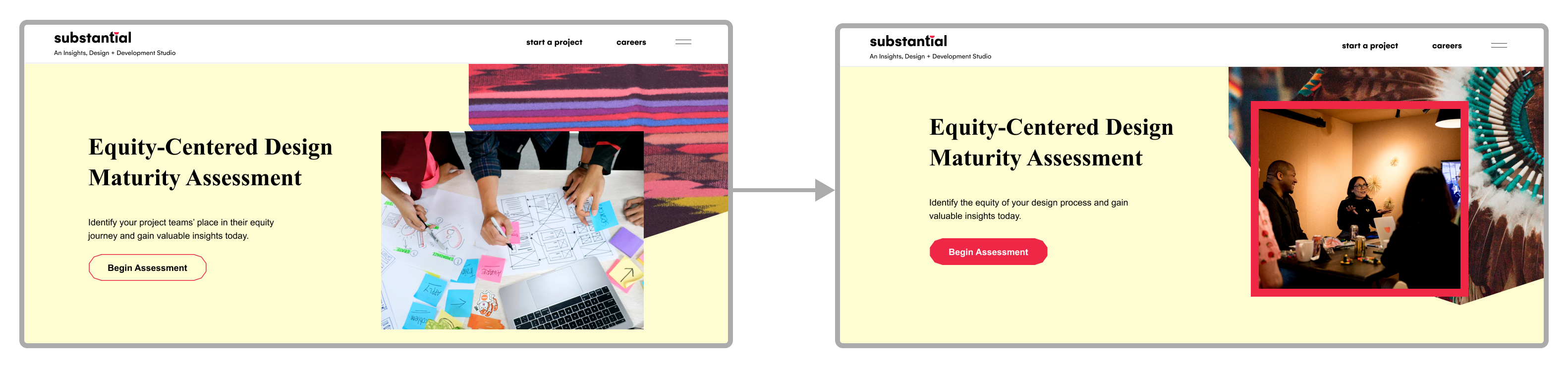
With established visual language, I created a set of mid-fidelity frames which we presented to the Substantial design team during an internal critique session. 

Based upon critique feedback, I adjusted our product copy and design to provide a more streamlined, brand-oriented experience.
Design Critque

Final Design

VIEW INTERACTIVE PROTOTYPE
After iterating on my previous wireframes and implementing design team critique feedback, I designed a high-fidelity interactive prototype in Figma.
Landing Page
Introduces assessment purpose, origins of ECD, social proof, and assessment content to elevate baseline user understanding and trust.
Assessment Introduction
To ensure a more seamless engagement with the assessment, users are informed that assessment is best at either the start of a project lifecycle or design phase. Introductory ECD language is provided to assist in content comprehension.
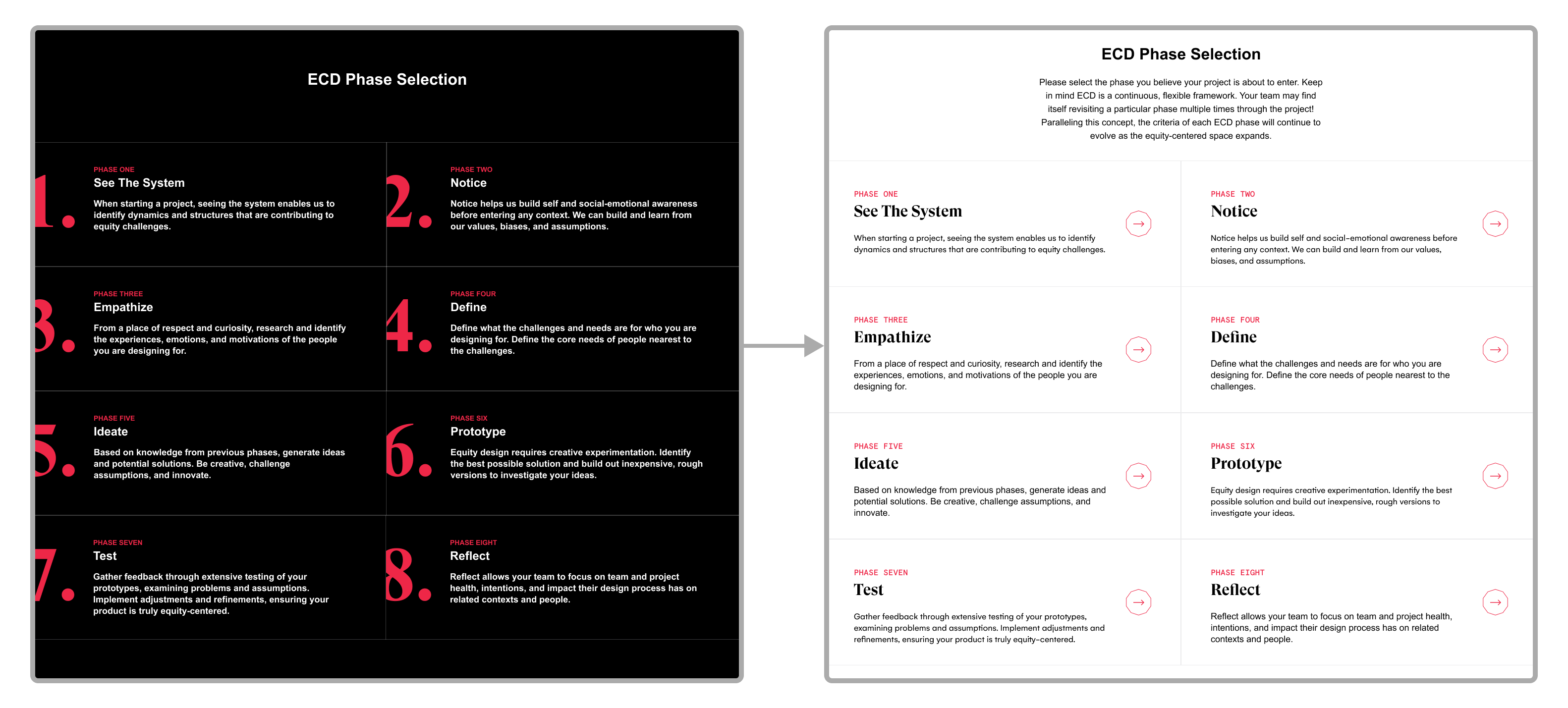
Phase Selection
Users are encouraged to select which design phase they are keen to assess. Re-iteration of the ECD lifecycle paired with short phase descriptions enable more informed phase selection.
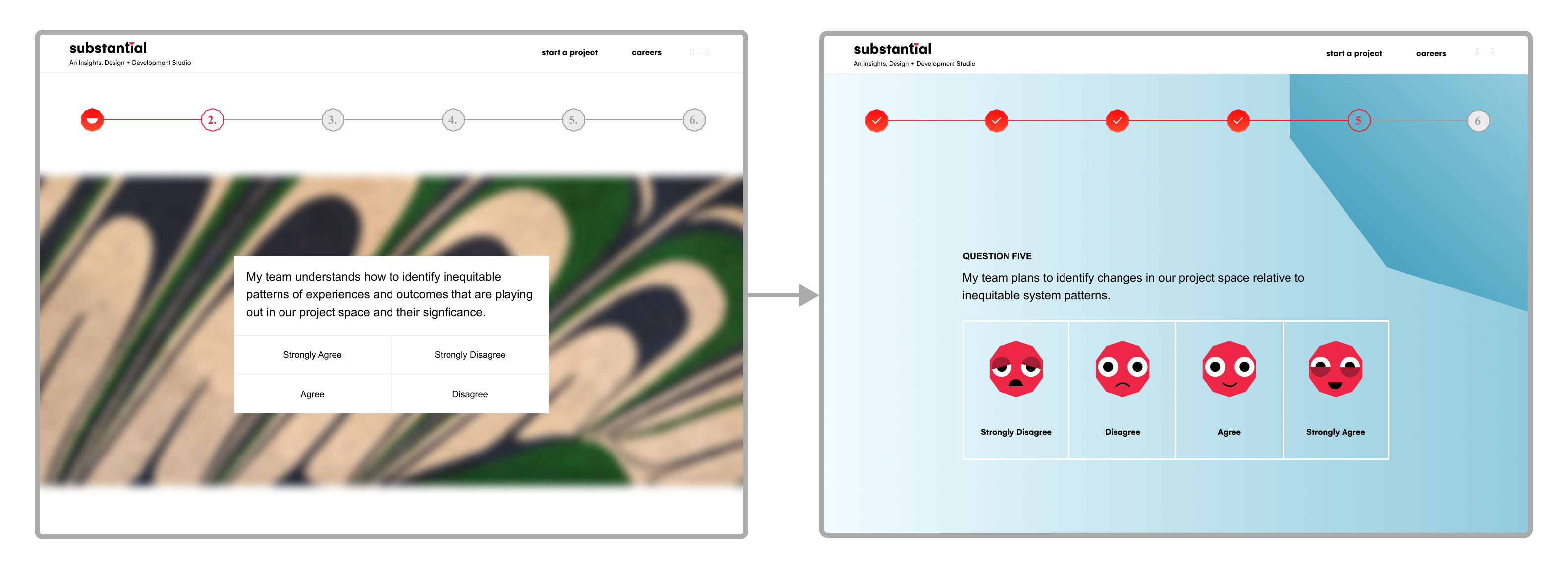
Assessment Questions
A detailed description of each phase coupled with short Likert-scale questions allow users to reflect on the equitability of their practices in a palatable, visually engaging, and interactive manner.
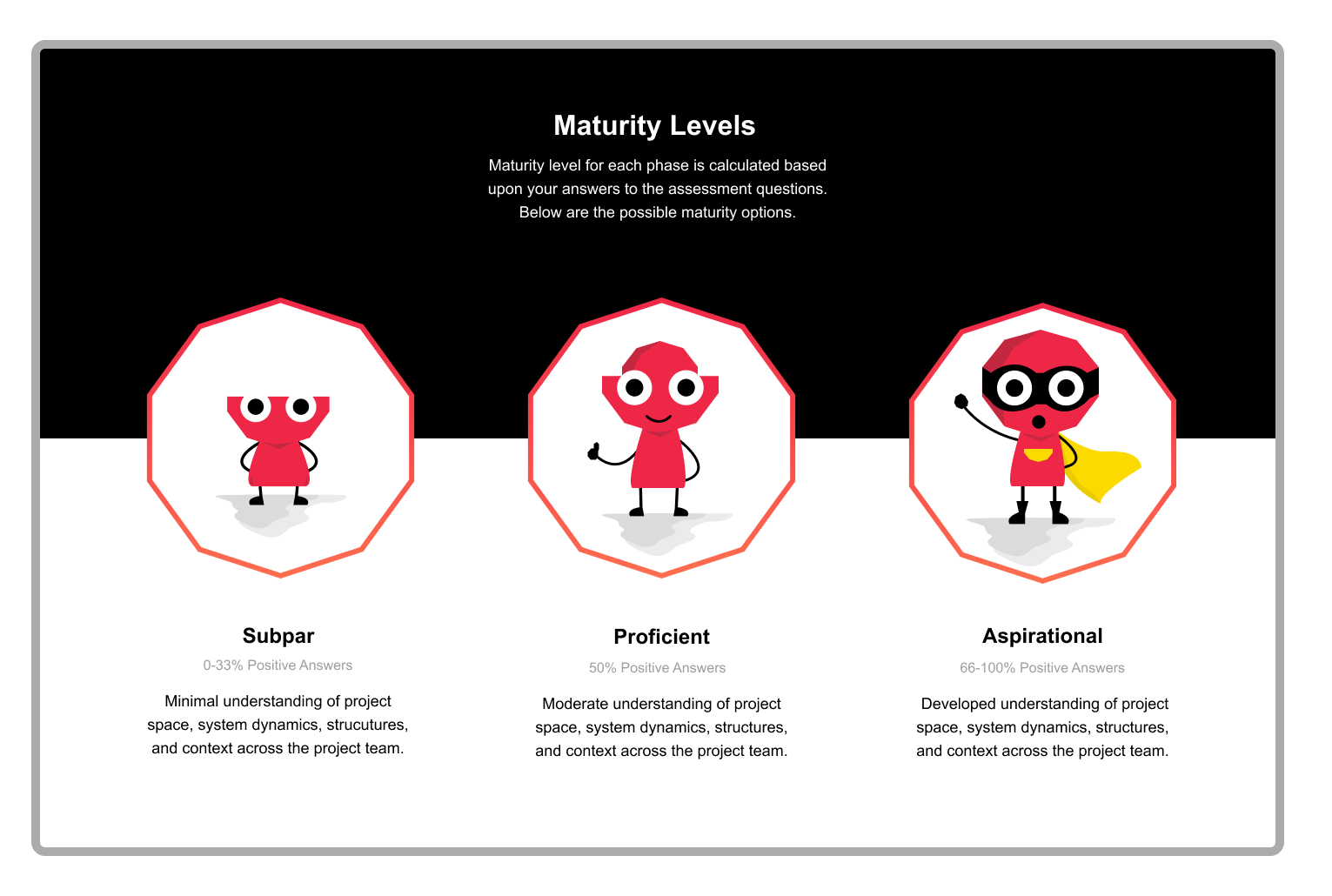
Final Results
Users are able to view their equity maturity level, answer distribution, learn actionable recommendations, and connect with Substantial experts to elevate their design process to a more equitable level.
Landing Page
Phase Selection
Assessment Introduction
ECD Language Guide
Phase One: See The System
See The System Question One
See The System Question Three
See The System Question Four
See The System Question Two
Assessment Results

Reflection

Through this internal project, I gained deeper understanding of the background and processes that encapsulate Equity-Centered Design. I was able to further developed my interviewing, synthesis, and website design abilities as well.  Engaging with individuals form the marketing team, leadership, and other designers and researches introduced me to new team, business, and industry dynamics that allowed grow as a collaborator and product designer.

If I were to continue this internal project, I would conduct research into the additional ECD Lifecyle phases to create copy and questions accordingly conduct user testing to ensure my design utility and experiential quality. Once design decisions are finalized, the development team would be able to build out the platform for an eventual product launch.
Sustainance
Refresh

Thanks for stopping by, feel free to explore my other projects!