Design Equity Assessment

Assessment boosts design equity understanding and client acquistion
My Role
Product Design
Intern
Skills
Visual Design
Design Systems
Equity-Centered Design
Duration
June - Aug 2022
(3 months)
Collaboration
UX Research Intern
Tools Used
Figma
Dovetail
Miro

Overview

The Problem

During my internship at Substantial, my co-intern and I created an Equity-Centered Design (ECD) assessment and client acquisition tool, drawing from the organization’s early-stage internal projects. ECD is a core principle at Substantial, building on Human-Centered Design by centering the voices and needs of historically underserved communities. It focuses on building relational trust, recognizing oppression, and transforming power dynamics.

As a newer framework, ECD can be challenging to fully understand and implement. Substantial is uniquely poised to support ECD-driven approaches and needed an innovative strategy to boost client acquisition in context of ECD.

Impact

100%
LEADERSHIP APPROVAL
CEO, Director, Management
$XXX
FUNDING
SECURED
Undisclosed Project Budget
20%
ACQUISITION
RATE
Projected Tool Benchmark

The Solution

I designed a web app that provides a palatable introduction to ECD, with a multi-step assessment for team's to identify design process equity maturity, gain actionable recommendations, and connect with Substantial experts to further expand assessment insights. This tool not only acts as a client-acquisition funnel, but establishes a strong foundation to build more equitable products.
I showcased the project with my co-intern during company-wide and leadership presentations. Our solution received wide-spread approval, impressing leadership and gaining funding for additional UX and engineering support.

Context

Strategic Project Foundations

Three internal projects were introduced to spark innovation and address key organizational needs. Each project was defined by a clear objective but maintained a flexible, open-ended scope to encourage creative solutions and exploration.

The 'Design Equity Assessment' was selected for its potential to address critical business goals around equitable design practices and lead generation.

Project Framing

Given the early-stage nature, establishing clarity to the project vision and how the selected initiative could deliver tangible business outcomes would be critical moving forward.

Highlight

Final Design

The assessment guides users through ECD, select which project stage they'd like to assess equity maturity, answer targeted questions, receive actionable recommendations, and connect with Substantial experts to expand upon results.

See Final Design for more details.

Research

Market Research

I led a competitive analysis on equity-centered design supportive solutions that currently exist on the market to inform our product direction. Several key insights are outlined below:

01 -  Highly generalized ECD recommendations.
02 - Little guidance on gauging lagging project areas.
03 - Text heavy, static content reduces engagement.

This signaled that our tool should provide a curated, actionable, and engaging experience for teams to elevate their design practices to a more equitable level.
Equity-Centered Design Resources

Expert Interview

My co-intern and I conducted 6 interviews with Substantial ECD practitioners to gain a deeper understanding of the the ECD space, including core tenets, implementations, and challenges within an industry setting.

I led a thematic analysis of our interview transcripts to generate several themes to guide our product direction:

01 - Concept, tooling, and terminology complexity reduces ECD palatability.
02 - Clients are often not well-versed in how to become equity-minded.
03 - ECD building works best with both self-assessment and third-party support.

Design

Ideation

Harnessing our research insights, I facilitated a workshop with my co-intern to generate strategic ideas on how to approach this assessment tool.

Our ideas centered around progressive disclosure, creating a baseline understanding of the ECD framework and then helping teams receive actionable, specific guidance to boost their process equity maturity.
Terminology Guide
Key terms and definitions to prompt initial equity thinking and improve user understanding of the framework and assessment.
 Baseline
Source Acknowledging
Include content on the creators and framework background to build a contextual understanding of the space.
Baseline
Diverse Representation
Include visual elements from historically marginalized communities to provide visibility, representation, and empowerment.
 Baseline
Process Assessment
Specific design process questions that encourage equity-based reflection within an non-intensive, introductory environment.
GUIDANCE
Actionable Results
Design equity maturity level, results rationale, and actionable recommendations to elevate process equity to the next maturity tier.
GUIDANCE
Expert Expansion
Connect with Substantial experts to expand on assessment insights and receive greater support in design process equity building.
GUIDANCE
Playbook Website
Provide reporting options & outcomes
 Novelty
Quality
Attribute Summary
Summarize missing report attributes
Quality
Automated Deduplication
Detect duplicate content in real time
 Novelty
Incentivized Structuring
Content based reward progression
 Novelty
Quality
Report Chatbot
Answers report content questions
 Novelty
Quality
Report Alerts
Alert if content violates guidelines
 Novelty
Quality

Lo-Fi Wireframing

Visual Language

I jumped into Figma to build out low-fidelity mockups, which allowed me to investigate initial product copy, information hierarchy, and interaction flows.

I presented this initial wireframes to my design manager and co-intern to gain some initial signal on design direction. This early feedback allowed me to refine these concepts before branching off to a higher fidelity.
I created the design guide below based on existing Substantial brand guidelines to ensure my higher-fidelity wireframes remained consistent with the set visual language parameters moving forwards.

Evaluation

Mid-Fi Critique

With established visual language, I created a set of mid-fidelity frames to maintain design flexibility while representing a more tangible look and feel.

I presented mid-fidelity wireframes to the Substantial design team during an internal critique session, adjusting product copy and design to provide a more streamlined, brand-oriented experience.
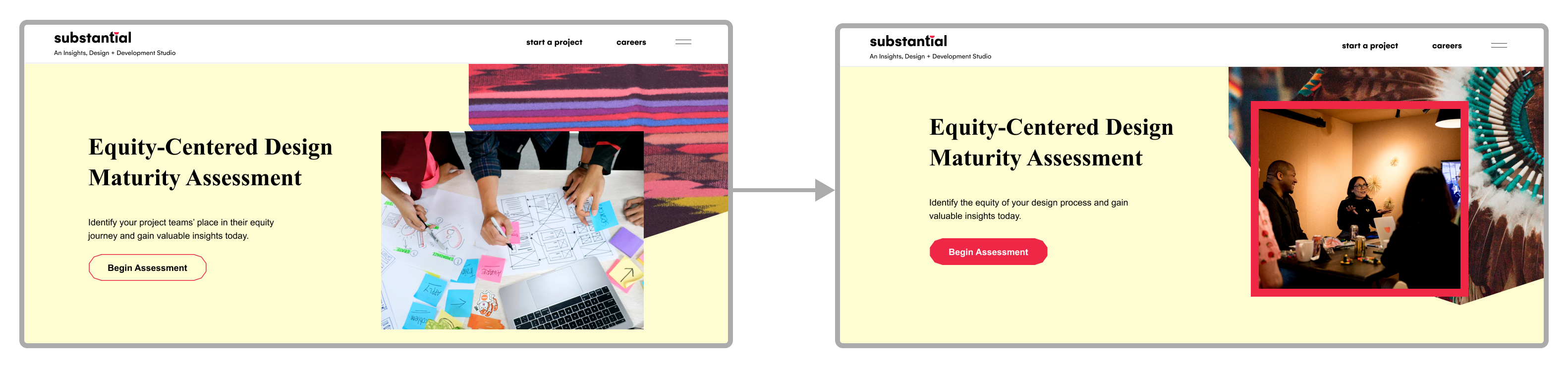
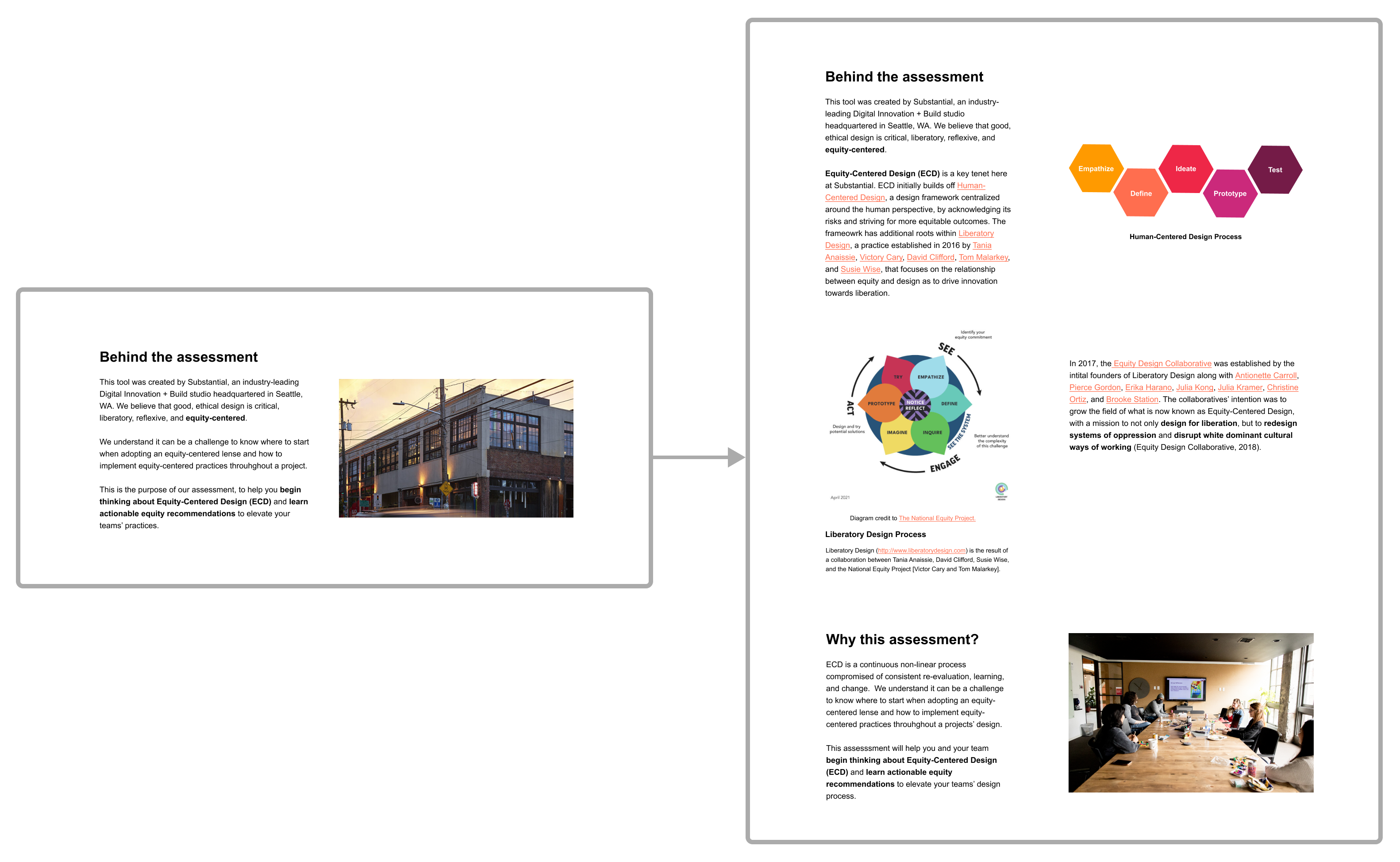
Tool Context Building

☝️Insight: Users must be able to build an understanding of ECD and the assessment to engage with the tool in a more intentional, informed manner.

✒️Action: Background information on ECD, supportive links, and custom visual aids.
Phase Selection Pivoting
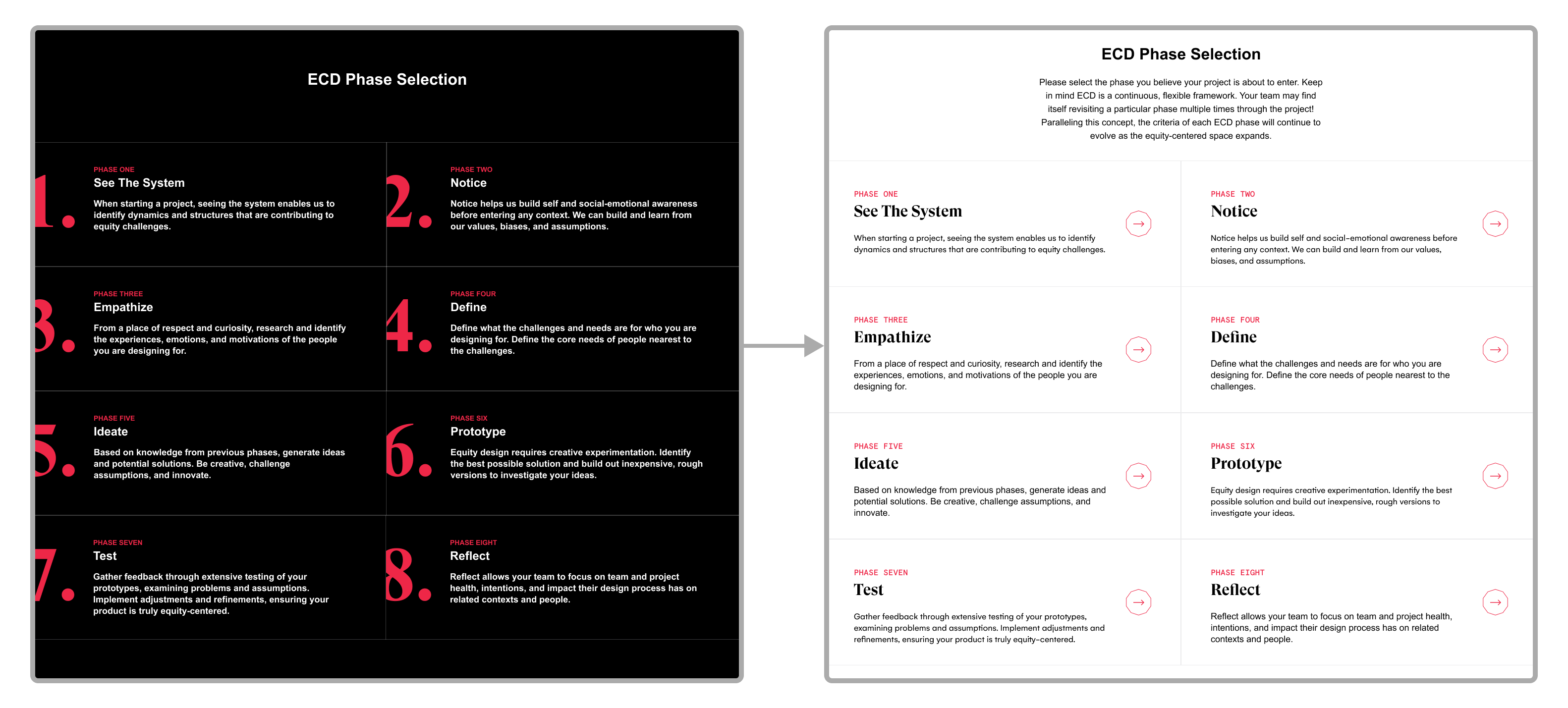
Hero Section Elevation

☝️Insight: Users should be offered a visually on-brand and guided experience to confidently select a design phase to assess maturity.

✒️Action: Section has instructional copy, arrow icons, larger headings, and light UI.
☝️Insight: Users should be presented a visually engaging, guided, and clean assessment experience to streamline input process and maintain high-quality, consistent design.

✒️Action: Singular gradient background, custom illustrated buttons building off Substantial logo, clear question headings, and check marks on progress bar.
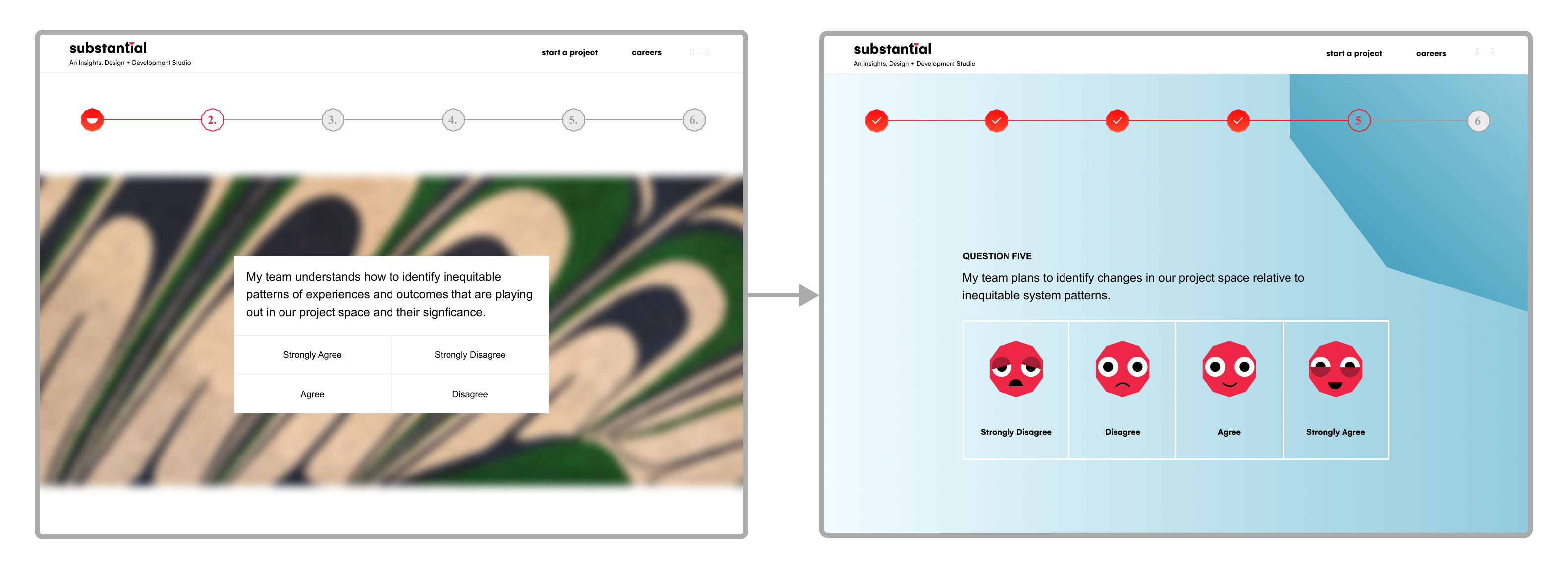
Assessment Refinement

☝️Insight: Users must be able to easily identify where to begin the assessment and view personable visuals to facilitate a positive initial impression.

✒️Action: Primary button solid background & image of the Substantial team.

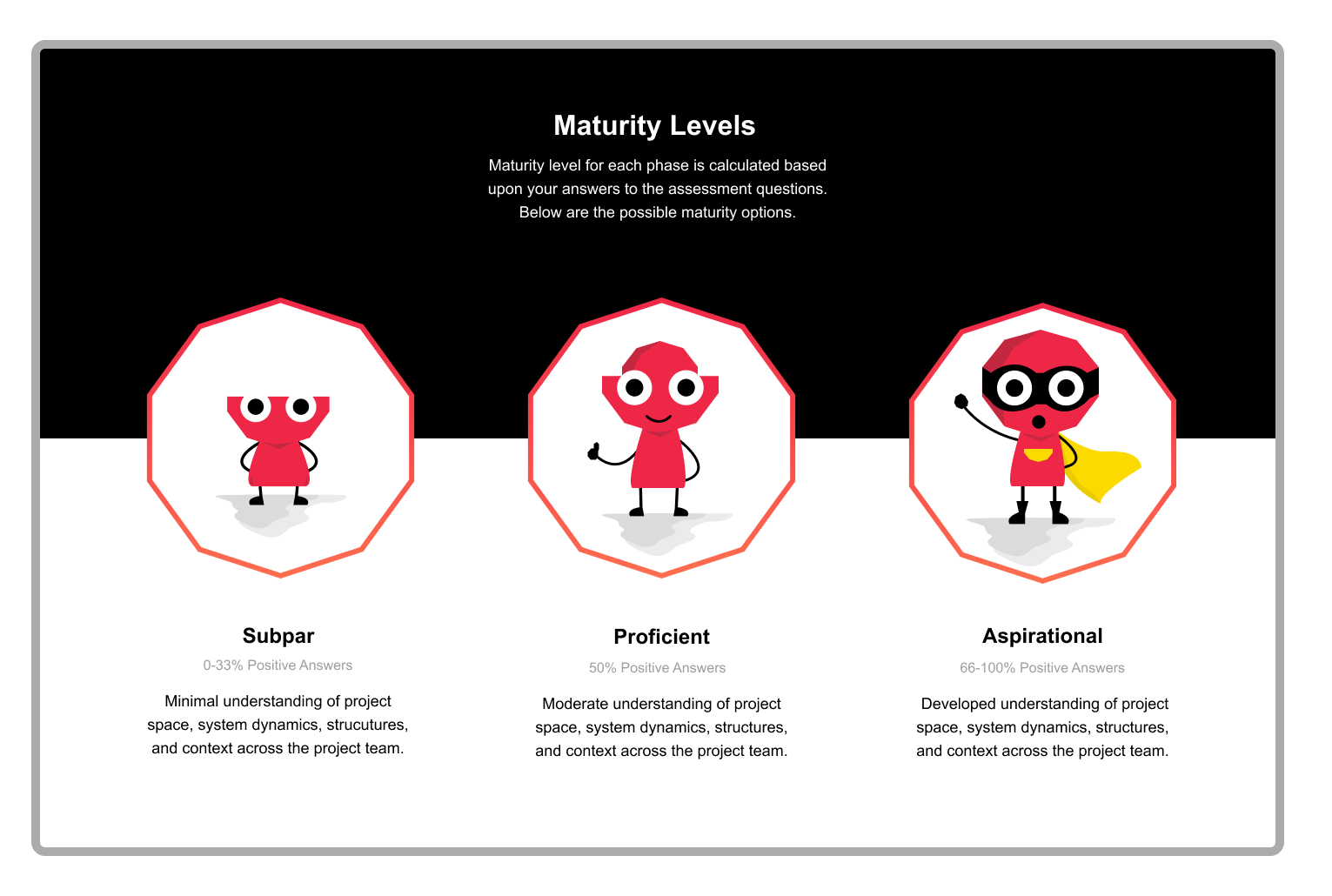
Maturity Tier Framing

☝️Insight: Users should be offered a slightly more supportive and positively framed maturity overview so they will feel encouraged to feedback and Substantial partnership.

🔮Future Work: Adjust maturity stage illustrations to not present as a deficit or absence, but intentionally crafted to be welcoming, supportive, and objective.
Final Design

After integrating evaluation insights into the design, I created a high-fidelity interactive prototype in Figma. I presented this to Substantial leadership and received approval for additional design and engineering support.
Landing Page
Introduces assessment purpose, origins of ECD, social proof, and assessment content to elevate baseline user understanding and trust.
Assessment Introduction
To ensure a more seamless engagement with the assessment, users are informed that assessment is best at either the start of a project lifecycle or design phase. Introductory ECD language is provided to assist in content comprehension.
Phase Selection
Users are encouraged to select which design phase they are keen to assess. Re-iteration of the ECD lifecycle paired with short phase descriptions enable more informed phase selection.
Assessment Questions
A detailed description of each phase coupled with short Likert-scale questions allow users to reflect on the equitability of their practices in a palatable, visually engaging, and interactive manner.
Final Results
Users are able to view their equity maturity level, answer distribution, learn actionable recommendations, and connect with Substantial experts to elevate their design process to a more equitable level.
Landing Page
Phase Selection
Assessment Introduction
ECD Language Guide
Phase One: See The System
See The System Question One
See The System Question Three
See The System Question Four
See The System Question Two
Assessment Results

Reflection

What I Learned
🗣️Strategic Design Communication: Effectively communicating design work is crucial for securing stakeholder approval and ongoing funding. By clearly articulating the value, impact, and strategic alignment of design decisions, I ensured that leadership understand the importance of investment.

🤝Intentional Stakeholder Collaboration: Connecting with other organizational functions, such as marketing, was essential for building broader support and adding valuable business context to our initiatives. By involving these teams early, I ensured my design work aligned with company goals, reached the right audiences, and benefited from additional perspectives.
Opportunity Areas
⚖️Defining Feedback Priorities: Looking back, I realize I invested more time adjusting less critical areas of the design, rather than prioritizing the most impactful feedback.

In the future, I’ll strive to better identify and address high-priority feedback to maximize value for both users and the business.

⌛Managing Time Effectively: Balancing several projects at once, I realized the importance of being more strategic and intentional with my time instead of spreading myself too thin across many tasks.

Next time, I aim to focus on high-impact work and make more deliberate decisions that ensure my contributions are meaningful and sustainable.
Substantial - App Conversion Flow
Google - Bug Report Automation

Next Project

Thank you for coming.
Let's continue this journey together!
© Sami Foell, 2026